
 Accommodation
 Day Visits
 Getting Here
 Snorkel & Dive
 Sustainability
| Guest Speaker | Date | Topic |
|---|---|---|
| Leaf to Reef Team | 14 & 23 June 2026 | 14th: Project Manta & 23rd: Leaf to Reef |
| Dr. Katherine Woodthorpe | 28 June 2026 | Building Resilience of The Great Barrier Reef |
| Barry McGovern | 27-29 July 2026 | Whales |
| Prof Jonti Horner | 11-14 September 2026 | Stargazing |
| Jacob Bowtell | 12 & 13 October 2026 | 12: The Health of Lady Elliot Island’s Sea Turtles & 13: Soft-Shell Syndrome: A Story of Collaboration |
| Leaf to Reef Team | 22 October 2026 |
Research in Action
|
| Prof Jonti Horner | 11-14 December 2026 |
Stargazing + Geminids Meteor Shower
|
*Subject to change
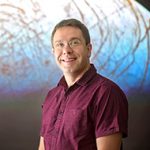
Jonti is an astrobiologist and astronomer based at the University of Southern Queensland. He is a passionate science communicator and teacher, and takes great pleasure from delving into the mysteries of the cosmos, and the question of life elsewhere.
Jonti first became interested in astronomy at the age of five, and has been hooked ever since. After spending his youth observing the night sky, and going to lectures at his local astronomical society, Jonti went to the University of Durham, where he spent four years studying towards a Masters’ degree in Physics and Astronomy. He then moved to the University of Oxford, where he obtained his doctorate for a thesis entitled ‘The Behaviour of Small Bodies in the Outer Solar System.’. Once his studies were complete, he moved to the University of Bern, in Switzerland, where he spent three years as a Postdoctoral Research Fellow. Spells at the UK’s Open University and the University of Durham followed, before he moved to Australia in 2010, to take up a position at the University of New South Wales. In 2014, Jonti accepted a position at the University of Southern Queensland, where he became the Vice-Chancellor’s Senior Research Fellow.
Jonti is a passionate and enthusiastic science communicator. He gives regular talks to a wide variety of community groups, schools, and astronomical societies, and makes monthly appearances on ABC Queensland’s Evenings program, with Trevor Jackson. His research covers topics ranging from the formation and evolution of our Solar system to the search for planets around other stars. He is particularly interested in understanding the different factors that could make some of those planets more (or less) suitable for the development of life, and is looking forward to seeing the next generation of astronomical telescopes make a serious effort at answering the question “Are We Alone?”.
Jonti writes regular articles for the Australian research news website The Conversation, which can be found at: https://theconversation.com/profiles/jonti-horner-3355/articles . His Twitter handle is @JontiHorner, and his personal webpage is located at http://jontihorner.com
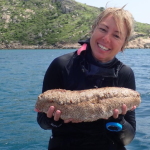
Ali Hammond is a marine scientist based in Hervey Bay, Queensland. As a Marine Parks Ranger, Ali is part of a multidisciplinary team responding to marine animal strandings, upholding compliance, and contributing to vital research and monitoring programs within the Great Sandy Marine Park.
Ali undertook her honours research with Southern Cross University, investigating the biology, ecology, and life history of holothurians (sea cucumbers). Despite fulfilling critical ecological roles in the marine environment, sea cucumbers are understudied and overfished in many parts of the world. Ali’s research has contributed to a wider awareness of these roles and increased protections for some species.
Ali is also cofounder of Turtles in Trouble Rescue, a volunteer sea turtle rescue group based on the Fraser Coast. In the past two years, TITR has grown from 14 members to a team of more than 90 trained first responders and citizen scientists, attending around 500 callouts annually for sick and injured marine turtles.
Leaf to Reef: Biodiversity of Lady Elliot Island is a research group apart of the Reef Islands initiative, which aims to establish a network of climate change refuges by protecting critical habitats in the Great Barrier Reef and use citizen science to quantify the biodiversity of Lady Elliot Island and surrounding waters.
Katherine is recognized as one of Australia’s most influential people in innovation. A scientist, industry leader and climate champion, she has led some of Australia’s most pioneering organisations working on the net zero transition and supporting the shift to decarbonise. Her particular passion is for the ocean and especially for the Great Barrier Reef and she has been to Lady Elliot many many times.
She was until recently the President of the Academy of Technology and Engineering and serves on the Board of the Great Barrier Reef Foundation and Chairs the advisory board of the Centre of Excellence for Our Future Oceans.
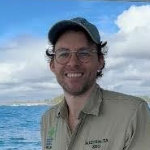
Jacob is a marine scientist with over a decade of experience in wildlife rehabilitation, specialising in sea turtles and sea snakes. He leads sea turtle and sea snake rehabilitation at the Australia Zoo Wildlife Hospital, where he has helped rehabilitate hundreds of sick and injured sea turtles and supported research and disease surveillance initiatives. His work has contributed to growing national attention on sea turtle health and conservation.
In collaboration with the University of the Sunshine Coast under Professor Kathy Townsend, Jacob is undertaking a PhD focused on improving the post-release success of rehabilitated sea turtles, with particular interest in sea turtle health, gut microbiomes, and disease ecology. This research is conducted across Lady Elliot Island, Hervey Bay, and Moreton Bay, Queensland, Australia.
Barry McGovern is a marine biologist and researcher with more than a decade of experience studying whales and dolphins in Australia and internationally. His work in Australia has focused on understanding the ecology, distribution, behaviour, and conservation of marine mammals, with particular interests in humpback whales, bottlenose dolphins, and Australian humpback dolphins.
Barry has led and contributed to a range of research projects from across the globe, including long-term photo-identification studies, population assessments, habitat modelling, behavioural studies and monitoring programs. His research has supported conservation management and improved understanding of how marine mammals use important coastal habitats.
Passionate about both science and education, Barry enjoys sharing stories from the field and helping connect people with marine wildlife.