
 Accommodation
 Day Visits
 Getting Here
 Snorkel & Dive
 Sustainability
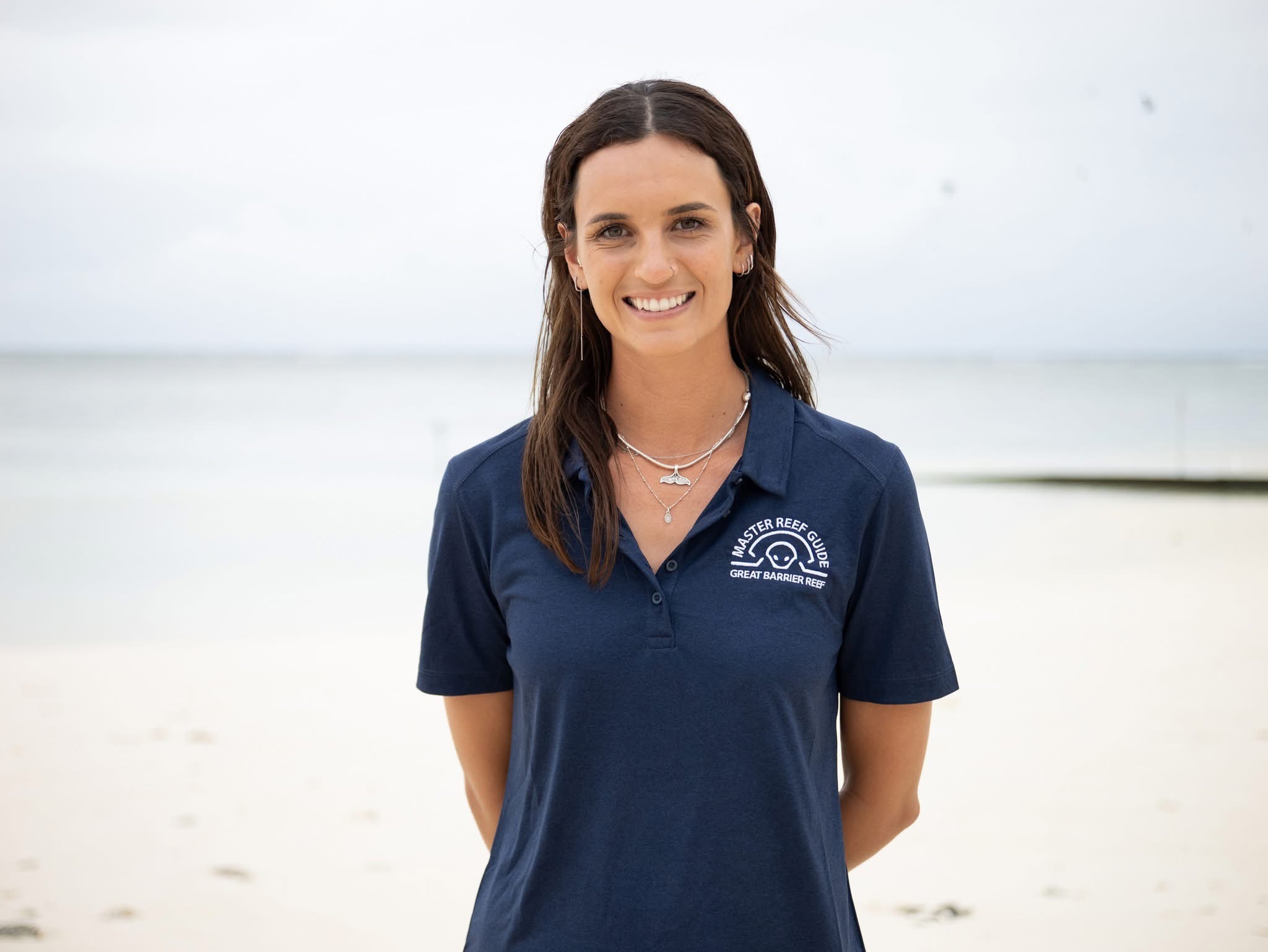



Where are you from, and what brought you to Lady Elliot Island?
I grew up in Brisbane and we did a family holiday to the Great Barrier Reef when I was 12, at that point I decided I wanted to be a marine biologist and I never looked back! We went on regular holidays to the reef, but in high school we went to Lady Elliot Island as part of a biology course. It was the Great Barrier Reef like I had never seen before – we saw a manta ray, dolphin and sharks in the first 10 minutes of the snorkel, while surrounded with the most amount of coral cover I had ever seen. I was utterly obsessed and always knew I would find my way back to the island.
What roles or experiences have you had in marine tourism, conservation, diving, research or education?
I have been in marine tourism since 2020 and have worked on Lady Elliot Island since 2023. Prior to working in tourism on the Great Barrier Reef, I completed a Bachelor of Science with a major in Marine Biology and I worked as a research assistant for the University of Queensland at Lizard Island and Heron Island, assisting PhD students with their field work. I have also worked as the Project Manager for CoralWatch and then as a marine biologist and dive instructor in the Philippines, where I developed a “Marine Biologist for a day” program. I also started an artificial reef structure, which I attached coral fragments to in the hopes of assisting the reef and fish population to recovery, after the reef was significantly damaged by a typhoon.
What does being a Master Reef Guide mean to you personally?
Being a Master Reef Guide means helping people fall in love with the reef. We show them all the reasons why they should love it and why they should feel inspired to protect the reef and all the wonderful animals that call it home.
What makes the island and its surrounding Reef special in your eyes?
In my opinion, there is no other place on the Great Barrier Reef that you can have an intimate experience with the reef, while swimming just off the shore, to be surrounded by manta rays, turtles, sharks, whales and some of the most abundant healthy coral cover. Our guest numbers are restricted by small planes so the island and surrounding reef never feel crowded or over populated. Being so far offshore and in a marine park, the quantity of rare or special encounters we get daily is unheard of anywhere else.
Tell us about a memorable moment you’ve had with marine life or guests on the Reef.
One of my favourite marine animal interactions was when I was guiding a snorkel safari for a school group and we had a humpback whale calf circle us three times. Our skipper was watching the whales and saw them divert from their route to come to swim with us. The calf was full of curiosity; you could see it making eye contact with all of us and it came so close I could have stuck my hand out to touch it. After that, I had 3 students ask me what they needed to do to be able to work here.
Another favourite moment, which is something we get semi-regularly, is when we have guests that have never snorkelled before join us on a snorkel tour. They are always a bit apprehensive, but as soon as they get comfortable, they don’t want to get out the water. To hear those guests describe that tour as “life-changing” is something I will never get sick of.
What do you hope people take away from their experience with you?
I hope that when our guests come and visit Lady Elliot Island, they leave feeling inspired to care for and protect the reef. We want to show them that the Great Barrier Reef is not dead, it is vulnerable and incredibly fragile in the current climate, but it needs all the help we can give it to stay resilient, and if our guests fall in love with the reef here, they’ll go home and do their part to help protect it.
How do you see your role as a Master Reef Guide contributing to the protection of the Great Barrier Reef?
My role as a Master Reef Guide is to use the tools and training that we have been provided to give guests an experience full of inspiration and passion. At the end of the day, the majority of guests won’t remember the exact number of fish species, or all the different names of the coral they saw, but they will remember the way that they felt. They’ll go home feeling inspired to protect something they feel passionate about and start making changes in their day to day, which will ultimately help protect the Great Barrier Reef.